On the Problem of Representing Psychosis in Comics

1.
I want to think about relationships between schizophrenia-spectrum illnesses and comics. Why? It seems like this nexus is not explored enough. There is some scholarship on art brut and comics, but not enough; and even less on the relationship between comics and schizophrenia-spectrum illnesses. What are the conceptual affinities between comics and schizophrenia-spectrum illnesses? Are there any? Surely it would be ridiculous to assert that comics are better fits for exploring schizophrenia-spectrum illnesses than other art forms, like music, say, or dance. Any attempts at being prescriptive when it comes to this nexus is doomed to fail.
Then why yoke them together?
Imagine there is a line.

On one side of the line is what we are traditionally and historically accustomed to. Let’s call the left side of the line “the space of reasons.” This is a phrase coined by the philosopher Wilfred Sellars, and it was intended to connote the unique space that human beings occupy, a space not only of sentience but sapience, where we can provide reasons for our behavior.

What happens when the space of reasons is ruptured, even shattered?
In a very real sense one’s perspective is shattered. One loses one’s autobiographical self, which is replaced by psychosis and a different sense of time and history. For example, one symptom that disrupts the space of reasons, and that is common for people living with a schizophrenia-spectrum illness, is delusions of reference. Delusions of reference are when a neutral stimulus is invested with a great deal of personal significance. Someone sniffs, and this seems darkly meaningful, like a clue leading through a labyrinth of ominous import. The most innocuous sentence is spoken, but behind it lurk gnostic messages about one’s own holiness. These experiences do not happen on the left hand of the line - they do not occur in the space of reasons. For when one experiences delusions of reference, the delusion seems immediately real and evident to the one experiencing them, but delusions are by nature unshared, while the space of reasons is shared. So how then does one represent delusions of reference? What do we draw on the right side of the line?
2.
Psychosis happens from a first-person perspective, but not from a second- or third-person perspective. When I hallucinated, (I have schizoaffective disorder), I saw private images that others could not see - colors mostly. This is hard to represent in any art form, including comics. Why? A hallucination is both visible and invisible. It’s visible in two senses - it appears in the mind’s eye of the hallucinator, and it might also appear in the facial features and body language of the hallucinator - a scrunched brow, fixated eyes - or in the faces and body language of those in proximity to the hallucinator - looks of bewilderment, fear, puzzlement, concern. But hallucinations are invisible because they are private - which is to say that it is something unshared, an unshared experience. How do you draw the visible invisible, or the invisible visible? How do you draw what does not occur in the space of reasons?
But aren’t our inner lives, in this sense, also invisible? And aren’t comics, in being interested in our inner lives, able to represent inner states of feeling in various ways? Yes, of course - but inner states of thought and feeling still happen within the space of reasons. This is what makes psychosis “ontologically different” - it does not happen within the space of reasons. This is an important point. So let me draw something on the right side that will juxtapose in a stark way with our space of reasons. How about a sheer black circle.

A black circle can suggest a kind of absent presence, which is good - many schizophrenia-spectrum illnesses involve both positive symptoms (positive meaning not emotionally good but rather symptoms that are present) like hallucinations and delusions, but also negative symptoms, like states of devitalization, depersonalization, and loss of pleasure.
But what is the relationship between psychosis and the space of reasons? For, as mentioned above, at the same time that hallucinations are visible and invisible, they also only occur, in terms of their experiential reality, in the first-person dimension. A doctor without a schizophrenia-spectrum illness understands the hallucination from a second- and third-person perspective, which allows for certain forms of clinical distance and objectivity, but not necessarily a rich and textured understanding of the first-person lived experience of the illness. There is a whole field - phenomenological psychopathology - that realizes how crucial this first-person mode of consciousness is, and studies lived experience phenomenologically. But how on earth does one represent these frissons, these clashes and collisions of perspective, in comics? What are the various ways in which the sheer black circle interacts with the orange square?
Let’s remove the line, and look at our drawing again.

Now there is a less stark division between the space of reasons and psychosis. This absence of a dividing line suggests there is a relationship between the space of reasons and psychosis. But what is it? We’ve said that psychosis is ontologically different than the space of reasons, so wouldn’t this require some symbol of difference between the two? Also, even if psychosis is unshared, the person experiencing psychosis still lives in the shared public world, even if they cannot see this. How do we represent that? What if we moved psychosis into the space of reasons?

This works, to a certain extent. We are trying to find a language to represent the relationship between psychosis and the space of reasons. And here we can see that, from the first-person perspective, someone living in a state of psychosis experiences the blotting out of the shared public world, and the space of reasons in which this world happens.
Yet what is scary to the person experiencing psychosis - and what is not represented in our last drawing - is that in a very real sense the shared social world is more primary, more fundamental, more primordial, than psychosis, since we are talking essentially about the world, the existence of the shared world, versus one individual’s private hallucinations. Perhaps this is partly why, when a person is psychotic, they can seem embattled. (I certainly was.) Their involuntary adherence to their psychosis means they are essentially experiencing what the scholar Clara Humpston has called “ontologically impossible experiences.” When I was psychotic, for example, I thought I was telepathic, because I was experiencing auditory hallucinations and interpreting them in my ill state as telepathic messages. But telepathy is not possible in our world. So I was essentially facing a kind of recalcitrance of the objective and social world, where telepathy is impossible. (It’s impossible because the world is determinate; it is a certain way. Red is not green. A square is not a circle.) But because the world is a certain way, some things - like thought insertion, thought broadcasting, delusions of reference, and telepathy - are not possible, at least in the space of reasons. The space of reasons is primary. So let’s change our drawing accordingly.

3.
And now it dawns on me - there is something crucial that is missing from our picture. Did you notice? We’ve been playing with abstract shapes, but there are no faces, no people, no others, including me. Why? In my own work, because of the solipsism of psychosis, I really rarely draw people other than myself, and when I do their function is sometimes to shatter the solipsistic isolation of the narrator or protagonist or to suggest the shared world. This works for me, because someone who is psychotic is usually incapable of seeing others as others. This is so because they project onto others their psychosis, without knowing they are doing this - a condition called anosognosia, or lack of insight. Drawing others in the context of psychosis is also complicated because the representation of other people can distract from a sense of the first-person perspective. Someone who is psychotic is locked into a state of being that is, in a very real sense, un-understandable to an other, but that is viscerally understandable to the one suffering with mental illness. But this too fails to capture the overallness of psychosis, the way in which it is total. When we are psychotic, we are psychotic. It affects every single ounce of self.
In addition to solitary figures, I also like using diagrams, arrows, and abstract shapes in my work. This is because people with schizophrenia-spectrum illnesses often lean towards abstraction. I’ve always liked this quote, from Louis Sass’s Madness and Modernism: Insanity in the Light of Modern Literature, Art, and Thought, my favorite book about schizophrenia-spectrum illnesses:
Many schizophrenics do seem to be highly preoccupied with experiences involving revelations of such cosmic or totalistic proportions - about the nature of existence in general or its fundamental relationship to the self. The experiential transformations they experience often have an all-encompassing quality, affecting not just this or that object but the look or feel of the entire experiential world. And as schizophrenics disengage from the social and pragmatic world, any focused, practical concerns they may have had tend to be replaced by preoccupations of a highly abstract or universal nature. (Sass 190-191)
“But the look or feel of the entire experiential world.” What is the feel of the experiential world, and how does this alter in psychosis? For me, my diagrams, arrows, and abstract shapes attempt to represent these kinds of preoccupations. Abstract shapes are simple and complicated - they seem both straightforward and infinitely malleable, infinitely polysemous (Rothko, for example). I like suggesting, with arrows, abstract shapes, and diagrams, a kind of logical mystery, or mysterious logic, that gets at how I feel sometimes when I’m symptomatic. I can feel disconnected sometimes, devitalized, depersonalized, and the world becomes unreal, but also enigmatic, like a form of apophany. These shapes help me somehow to express the strange logic of living with a schizophrenia-spectrum illness.
But let’s get back to our shapes. Is our last drawing satisfactory? What if we replaced it with a face, the kind of face I often draw in my cartoons? Will this help “put a human face on the illness”? Let’s see:
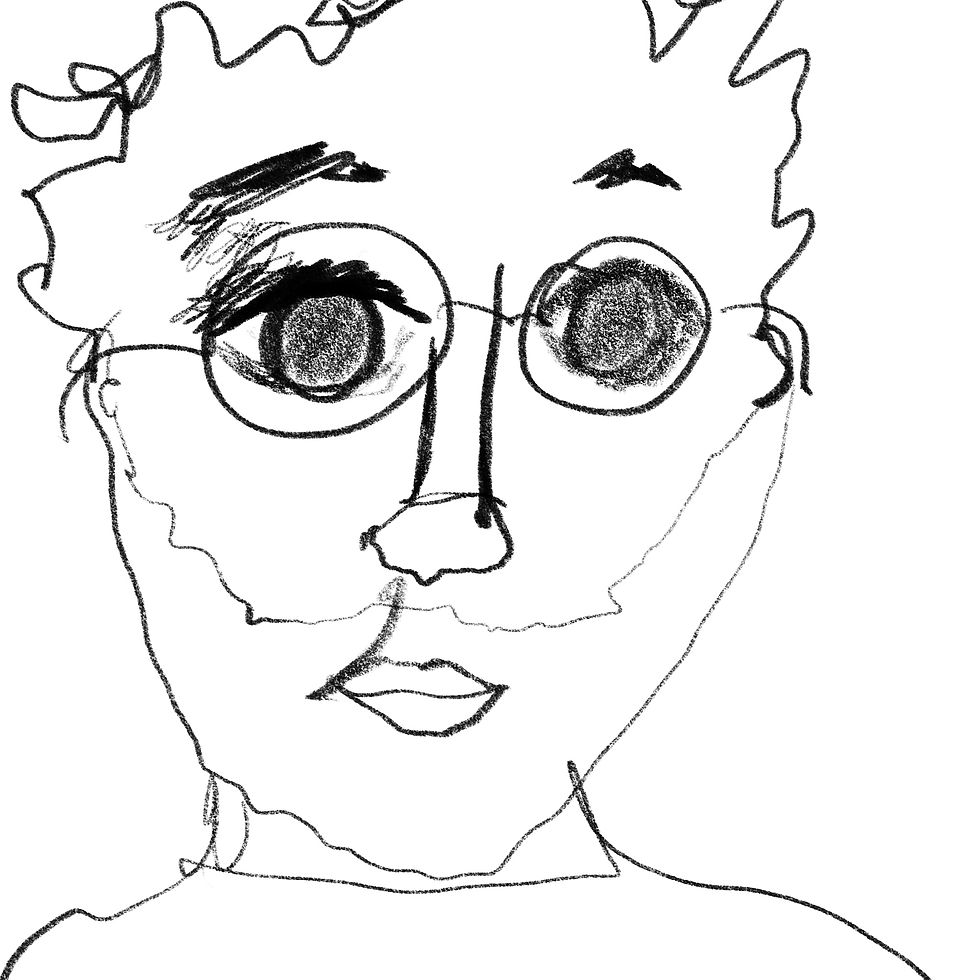
We have moved from the abstract to the concrete. But does this help to represent schizophrenia-spectrum illnesses, or hinder it? How do we understand this gentleman’s face? It seems kind of tentative, with the parsed lips and the slightly raised eyebrows. What is he thinking? Let’s give him a thought bubble with some words.

Have we moved any closer to representing psychosis, representing the experience of schizophrenia-spectrum illnesses, with any degree of verisimilitude? Well, absent of any context for our protagonist, it is very difficult to say what is happening. But let’s look closer at the image, and see if we can glean anything. First, we are close to the protagonist’s face. We do not see his whole body. Does this bring us closer to him somehow, or to what he is thinking, or both? And his thinking, his thought - how does that interact with his facial expression? There is something cold, stony, in his eyes that seems as though he were surveying a room of people, and beginning to think that no one understands him. Or perhaps he is already lost in the thought that “no one understands me.” But this dawning recognition itself seems somewhat resigned, sad, but not overwhelming. Our protagonist seems to have some distance from his thought, or from the feelings his thought might bring up.
Notice how much information one drawing conveys. I think this is why I sometimes prefer abstract shapes. They can help to provide a conceptual clarity that is muddied or made overwhelmingly complicated by the appearance of a face or others, even if the face or the others are crucial for the story I want to tell. But my goal in this essay is to explore ways of representing schizophrenia-spectrum illnesses. And one symptoms of living with schizoaffective disorder is a hyperreflexiveness, which means living a lot of the time in one’s own head. How could one represent this? I think that’s why I often do not draw whole bodies, but usually focus on close-ups of my face or others’ faces. The closeness to the face is a kind of proxy for abstract shapes - both can allow the reader to feel something of the living-inside-their-own-headness, a kind of abstractness.
4.
When I was ill, I thought people were inserting their thoughts into my mind. That means it was as if I were reading various thought bubbles coming from the faces and minds of other people. Of course, the thought bubble is a convention - we don’t actually see thought bubbles when we experience thought insertion. And when we read a comic, we don't believe we are mind-reading in the sense involved with schizophrenia-spectrum illnesses. The tacit assumption is that we are playing a kind of game, where speech and thought are represented in a certain way. But how might we represent something like thought insertion, or delusions of reference, in a comic? How would one represent psychosis, delusions, hallucinations? Let’s return to our face, but shrink it a little.

Now we have our protagonist talking, seemingly, to someone, while also thinking. The words are sliding out of the thought bubble, in order to convey a kind of meaninglessness to what is being said. At the same time the protagonist is speaking, he is thinking “no one seems to understand me,” a thought whose sentiment contributes to the feeling of meaninglessness. Yet if the protagonist is talking to another person, we not see them, nor does the protagonist seem to see them - their eyes do not appear to be looking at another person, but instead seem to be somewhat introspective. Let me add another person, and we can see how they interact.

A few things are happening. First, as soon as a second person is drawn, the shared public world is being somehow instituted or constituted. With a solitary figure, the shared social world can be in the background, but when you introduce a second person, the shared world seems to emerge into the foreground. We seem to recognize ourselves more here, in a sense, at least socially. We can see that the person on the right is looking at our protagonist, but he is not looking at her, though they are having a conversation. Then, strangely, after the person on the right is done speaking about the movie, they say “you are God.” I drew this because I want to figure out how to convey delusions of reference, the experience of hearing secret messages behind words. I don’t think this attempt is successful, because it doesn’t suggest the rupture involved with the delusion - it’s not that seamless. Let's draw it again.

That seems to work better. The caption provides context, which the image tries to provide a slant on, to somehow represent. But it raises lots of questions, as if there were something about conventional thought and speech bubbles that are recalcitrant to the representation of psychosis. Writing "You are God" in a different color, and making the representation of that statement kind of floaty through the suggestion of both thought and speech via the separated lines in the oval seems to work somehow. What do you think?
There is something else about representation that we hinted at above, and this involves a conundrum: namely, that I turned to comics to learn how to represent psychosis, but have learned that I face the same challenge as a comics artist that I face in the world - how to convey the unshared, un-understandable quality of psychosis, when, as soon as the work is shared, it is in the public world, in the I-Thou relationship between reader and text. In other words, the conditions for understanding psychosis always militate against understanding psychosis, because understanding takes place in the space of reasons, and psychosis does not. There isn't a language of psychosis, because for a language to be a language, it has to be shared. And psychosis is unshared. So how do we represent it?
Here are more examples of ways I have tried to represent symptoms of psychosis:


Note that these drawings, though they are taken from longer comics, don't really have a setting, a thick context. I like this - part of being in your head alot, or engaging with abstraction, is a loss at times of the physical or perceptual world. This hyperreflexiveness can then cause a feeling of placelessness, of a worldless world, especially when a person is psychotic. For if a world is a totality of references, as Heidegger argued, what kind of world is the psychotic world? We could say that the psychotic world is privative and enclosed. This is what makes it worldless.
I think my comics also rarely have a background, because psychosis is ontologically different, and this means that the being of a person experiencing psychosis has changed. If we define "being" as the background of social practices that orient us in the world - how we use language, or stand in an elevator, or paint a picture - then our very being changes when we are psychotic, because we function with and from a different set of background practices. To use a term from the scholar Matthew Ratcliffe's work, our "existential feelings" - our sense of reality - has changed.
When your sense of reality changes, your background changes. This is hard to get at in words. It's also why I try to use color in a different way. Sometimes I use a lot of color to convey the trauma of psychosis, a kind of overwhelming loudness, and sometimes I use a small amount of color. A large amount can get at the positive symptoms (hallucinations, delusions, mania), while a small amount can get at the negative symptoms (alogia, anhedonia, depression, asociality, devitalization). But color is useful because color is abstract, in the sense that we can speak not only of a red apple but redness. This conceptual quality of color represents a form of abstraction that seems amenable to people with schizophrenia-spectrum illnesses. There is also something strange about color, as a property of objects - it seems itself to create a kind of background or mood, similar to how psychosis does. And yet the mood created by color is mostly unnoticed, and so is psychosis when one is experiencing anosognosia.


Comments